Thermal Management and Interface Solutions for the LED Lighting Market
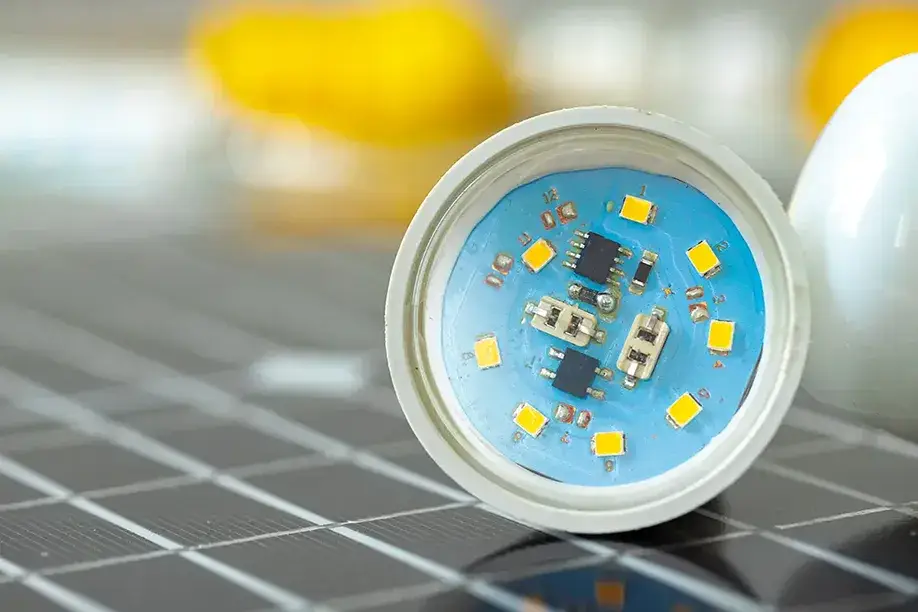
The latest innovations in the lighting market are driven by the rapid adoption of high-power LED technology. Today, the main challenge for design engineers is not only generating high-quality light, but managing the intense heat concentrated in increasingly compact spaces. Ineffective thermal management inevitably leads to rapid degradation of the LED chip, color shift, and premature failure of the entire fixture.
Euro Technologies, as an official distributor of Laird products (now part of Qnity Electronics), is at the forefront of this sector, assisting engineers in developing thinner, more reliable, and highly competitive lighting solutions for the global market.
The Importance of Thermal Interface Materials (TIM) in LED Systems
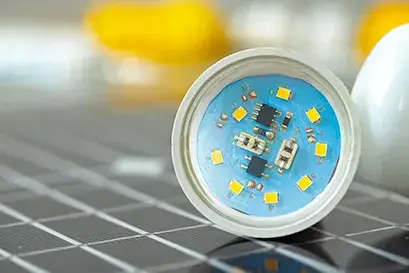
With growing demand for high-performance lighting fixtures—ranging from architectural and street lighting to automotive headlights—passive heat dissipation becomes a critical design parameter. Euro Technologies provides customized Thermal Interface Materials (TIM), essential for filling microscopic air gaps between the LED Printed Circuit Board (PCB) and the aluminum heatsink.
Using the right interface materials drastically reduces the thermal resistance of the system, extending product operating life (L70/L90 metrics) and ensuring consistent luminous flux over time.
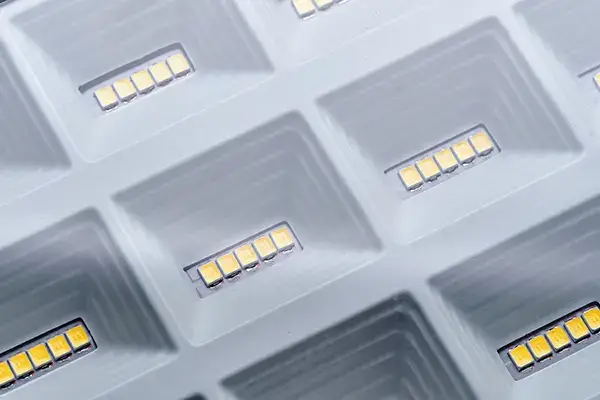
Product for the Lighting Sector
We deliver custom-cut, CNC-machined, or automatically dispensed solutions tailored to fit the complex geometries of modern lighting fixtures:
- Thermal Gap Fillers: Highly conformable silicone or silicone-free thermal pads (ideal for siloxane-sensitive optical systems). They absorb mechanical tolerances between components, ensuring optimal thermal transfer without exerting mechanical stress on the PCB.
- Liquid Gap Fillers & Dispensed Gaskets: Two-component systems applied via automated robotics (using Form-in-Place technology), ideal for high-volume production lines and filling complex three-dimensional cavities around LED drivers and modules.
- Phase Change Materials: Solutions that remain solid at room temperature but soften at LED operating temperatures, perfectly wetting contact surfaces for minimal thermal resistance.
- Environmental Sealing Gaskets: Beyond heat management, outdoor LED fixtures require weather protection. Our silicone and elastomeric gaskets protect electronic components from moisture, dust, and rain (IP67/IP68 ingress protection).
- EMI/EMC Shielding: LED drivers and switched-mode power supplies (SMPS) can generate electromagnetic interference. We offer shielding solutions to ensure regulatory compliance (EMC directives) and prevent flickering or interference with nearby electronic equipment.
Q&A: Frequently Asked Questions on LED Thermal Management
Why is it necessary to use a Gap Filler or Thermal Interface Material (TIM) in LED lighting devices?
The mating surfaces of the LED PCB and the aluminum heatsink contain microscopic roughness. Without a Thermal Interface Material (TIM), these air pockets act as thermal insulators. The interface material fills these gaps, drastically lowering thermal resistance and allowing heat to flow efficiently into the heatsink, preventing LED chip overheating.
What is the difference between a solid pad Gap Filler and a liquid dispensed Gap Filler for LED applications?
A solid Gap Filler pad is a pre-cut thermal cushion ideal for uniform gaps and flat surfaces, making it easy to assemble manually. A liquid Gap Filler applied via automated dispensing is the optimal choice for high-volume manufacturing or complex 3D geometries, as it eliminates mechanical stress on delicate soldered components on the LED board.
Do LED lighting systems also require EMI/EMC shielding solutions?
Yes, in many cases they are essential. While the LED chip itself produces minimal noise, the power supply and LED driver (especially high-efficiency switching drivers) can emit high-frequency electromagnetic noise. Utilizing EMI shielding and conductive gaskets suppresses radiated emissions, ensuring the fixture passes EMC compatibility tests and avoids interfering with nearby Wi-Fi, radio, or other electronic equipment.